
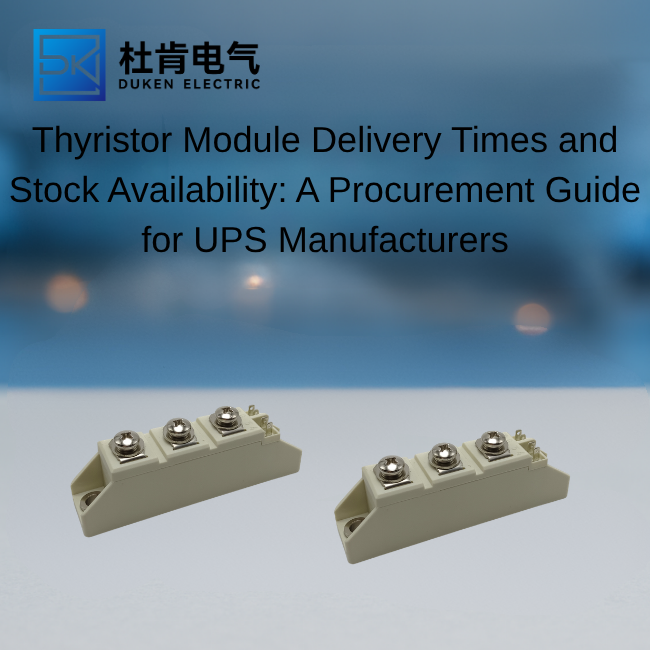
Thyristor Module Delivery Times and Stock Availability: A Procurement Guide for UPS Manufacturers
Delivery times and stock availability for thyristor modules can become as important as electrical specifications when an industrial UPS manufacturer is facing a production deadline, maintenance shutdown, or urgent replacement requirement. A module may be technically perfect, but a 10-week lead time can make it commercially unusable. Conversely, choosing an immediately available module without checking circuit configuration, voltage class, thermal design, and mechanical compatibility can create a much more expensive problem after installation.
This is particularly relevant when sourcing a certified full-module hard-soldered-joints 106A thyristor module for UPS systems or a water-cooling anti-parallel phase-control 106A thyristor module for UPS systems. Procurement teams should therefore evaluate availability together with technical equivalence, production status, supplier inventory strategy, and future replenishment capability.
Why Thyristor Module Lead Times Vary So Much Between Suppliers
A supplier showing a thyristor module in a catalog does not necessarily have that exact configuration available for immediate shipment.
This creates several different meanings of the word “stock.”
Finished-goods stock means the required module is already assembled and available subject to final inspection. Semi-finished stock may mean the supplier has semiconductor chips, baseplates, housings, terminals, or other critical materials but still needs to complete assembly and testing. Material availability means production can start quickly, but the product is not physically ready for shipment.
These situations can produce very different delivery times.
For a certified full-module hard-soldered-joints 106A thyristor module for UPS systems, buyers should therefore ask whether the quoted availability refers to completed modules or only available production materials.
Hard-soldered construction also illustrates why manufacturing lead time cannot always be compressed simply because an order is urgent. Semiconductor assembly requires controlled processes, followed by electrical and quality verification. Skipping necessary production or testing stages to save several days can create reliability risks that are unacceptable in UPS equipment.
Certification requirements can add another consideration. Procurement teams should clarify whether certificates apply to the manufacturer, quality-management system, product family, or exact model being purchased. The word “certified” should be supported by relevant documentation rather than treated as a general marketing description.
The order quantity also changes the delivery calculation.
A supplier may have 20 modules available immediately but receive an inquiry for 300 pieces. In that situation, the correct delivery schedule may involve partial shipment from existing stock followed by production of the remaining quantity.
For OEM buyers, this can be more useful than waiting until the entire order is complete.
Stock Availability Should Be Checked Against the Exact 106A Module Configuration
A 106A current rating alone does not define a thyristor module.
The first technical question is the internal topology. Depending on the application, a module may contain two thyristors in a particular connection, a thyristor-diode combination, or another circuit arrangement.
An anti-parallel thyristor configuration, for example, is particularly useful for AC phase control because the two SCRs can control opposite half-cycles.
This makes a water-cooling anti-parallel phase-control 106A thyristor module for UPS systems fundamentally different from a module with another internal circuit, even if both products have similar current and voltage ratings.
Voltage class must also be confirmed.
The repetitive blocking capability should match the real circuit with appropriate engineering margin. Buyers should not substitute a lower-voltage module simply because it is available from stock.
Current ratings require similar care.
A 106A module rating is established under specified thermal and electrical conditions. Actual usable current depends on factors including conduction angle, waveform, case temperature, cooling system, junction-temperature limits, and the manufacturer's rating conditions.
Thermal parameters therefore belong in the stock-qualification process.
Rth(j-c), or junction-to-case thermal resistance, helps engineers understand how conduction losses translate into junction-temperature rise. A simplified relationship is:
Tj = Tc + P × Rth(j-c)
SCR conduction loss can also be approximated for preliminary analysis using:
Pcond ≈ VT × IT(avg)
These simplified relationships illustrate why a mechanically compatible stock module is not automatically a thermally equivalent replacement.
Gate characteristics matter as well. SCRs are turned on through their gate but, unlike an IGBT, a conventional thyristor is not normally turned off through that gate. It remains conducting until current falls below the required holding condition or the circuit commutates it off.
For UPS phase-control applications, the gate-drive circuit must therefore be compatible with the replacement module's triggering requirements.
Before accepting an available alternative, engineers should compare gate trigger current and voltage, on-state voltage, surge current, thermal resistance, blocking voltage, internal circuit, dimensions, terminal layout, and mounting requirements.
UPS Manufacturers Need a Different Inventory Strategy from Repair Buyers
The importance of delivery times and stock availability for thyristor modules changes according to the buyer's role.
A repair company may need two modules immediately because a customer's UPS is already offline. In this situation, existing finished stock and mechanical compatibility may be the highest priorities.
An OEM manufacturing hundreds of UPS units has a different problem.
The lowest unit price is of limited value if the supplier cannot support repeat orders. The OEM needs to know normal production lead time, available capacity, minimum economic production quantities, critical-material availability, and whether future batches will remain consistent with approved samples.
Distributors face another inventory challenge because they need to predict demand across several customers.
A distributor stocking a certified full-module hard-soldered-joints 106A thyristor module for UPS systems should understand whether the model is widely interchangeable or tied to a relatively narrow application. Excess inventory creates capital pressure, while insufficient inventory creates lost sales when an urgent MRO inquiry appears.
A practical sourcing strategy is therefore to separate demand into predictable production requirements and emergency requirements.
Predictable OEM demand can be supported by forecasts, scheduled orders, or agreed inventory planning. Emergency MRO demand benefits from finished-goods safety stock of frequently requested models.
For large projects, partial shipment can connect these two strategies. Existing stock can support the first production requirement while the balance is manufactured.
This is often more effective than asking the supplier to shorten every manufacturing process.
Water-Cooled and Anti-Parallel Modules Require More Than a Stock Check
A supplier may have a 106A anti-parallel module available, but that does not guarantee compatibility with an existing water-cooled assembly.
Mechanical dimensions, baseplate design, mounting-hole positions, terminal locations, and electrical clearances need to match the equipment.
Thermal interfaces deserve particular attention.
A water-cooling anti-parallel phase-control 106A thyristor module for UPS systems can benefit from efficient liquid cooling, but the semiconductor still generates conduction losses. Coolant inlet temperature, flow conditions, interface quality, and heat generated by neighboring power devices influence the final junction temperature.
A replacement with different on-state voltage or thermal resistance may therefore operate at a different temperature on the same cooling plate.
Mechanical installation must also follow the relevant manufacturer's recommendations. Mounting torque or clamping requirements should not be assumed from another model.
This becomes especially important when an urgent replacement encourages buyers to choose whatever product is currently available.
Stock can solve a delivery problem, but it cannot solve a topology or thermal mismatch.
Compared with IGBTs, thyristor modules are often attractive in UPS rectification and line-frequency phase-control stages because SCRs provide rugged high-current operation and strong surge capability with relatively simple control. IGBTs become more appropriate where active high-frequency PWM and gate-controlled turn-off are required.
SiC devices can provide substantial advantages in high-frequency conversion, but they are not universal direct replacements for SCR phase-control modules.
Technology choice should therefore be determined by circuit function before availability is considered.
How Buyers Can Reduce Future Thyristor Module Lead-Time Risk
The best time to solve a delivery problem is before the required module becomes unavailable.
OEM buyers can begin by identifying which thyristor modules are production-critical. Current rating, voltage class, circuit configuration, package dimensions, gate requirements, and approved alternatives should be documented.
Second-source qualification can then be completed while the original component is still available.
This gives engineers time to compare samples, verify electrical characteristics, check mechanical fit, and perform thermal testing without the pressure of a stopped production line.
For a certified full-module hard-soldered-joints 106A thyristor module for UPS systems, second-source qualification should include construction and production consistency in addition to electrical parameters.
For a water-cooling anti-parallel phase-control 106A thyristor module for UPS systems, the qualification should also reproduce the intended cooling and phase-control conditions as closely as practical.
Forecast communication can further reduce lead-time risk.
Suppliers can plan semiconductor chips, housings, baseplates, and production capacity more effectively when they understand expected demand. Buyers do not necessarily need to hold every piece physically in their own warehouse if the supply arrangement provides adequate visibility and replenishment planning.
For critical modules, an agreed safety-stock level can provide additional protection.
This turns delivery times and stock availability for thyristor modules from an emergency purchasing issue into a manageable supply-chain parameter.
Conclusion
For UPS manufacturers, distributors, and MRO buyers, thyristor module availability should never be separated from technical qualification. Immediate stock is valuable only when the module has the correct current and voltage class, internal circuit, gate characteristics, thermal performance, package dimensions, and mounting requirements.
A 106A module available today may be useful for an emergency repair, while a production program may require a supplier capable of supporting consistent batches over several years. Buyers should therefore distinguish finished stock from semi-finished materials and normal production capacity when discussing delivery.
For specialized products such as hard-soldered modules or water-cooled anti-parallel configurations, early forecasting and second-source approval can substantially reduce procurement risk.
Ultimately, effective management of delivery times and stock availability for thyristor modules is not about finding the fastest supplier for one order. It is about building a supply strategy in which the correct semiconductor can be obtained when production, maintenance, or customers actually need it.
FAQ
Q1: Does “in stock” always mean thyristor modules can ship immediately?
No. Stock may refer to finished modules, semi-finished assemblies, or available production materials. Buyers should ask what is physically completed and ready for final inspection or shipment.
Q2: Can any 106A thyristor module replace another 106A model?
No. Voltage class, topology, gate parameters, surge capability, thermal resistance, dimensions, terminals, and mounting requirements must also be compared.
Q3: What is an anti-parallel thyristor module used for?
Two SCRs connected in anti-parallel can control opposite half-cycles of AC power, making the configuration useful in phase-control applications.
Q4: Is water cooling enough to qualify an alternative module?
No. Water cooling improves heat removal, but on-state loss, Rth(j-c), package compatibility, coolant conditions, and installation requirements still need evaluation.
Q5: How can an OEM reduce future module lead times?
Forecasting demand, qualifying a second source, maintaining safety stock for critical models, and planning production with suppliers can reduce the risk of emergency shortages.
READ MORE:
Pre-Shipment Testing and Technical Support for 106A Thyristor Modules in UPS Projects
Repeated Thyristor Module Failures in UPS Systems: A Root-Cause Analysis Guide
Thermal Troubleshooting of 106A Thyristor Modules: Why UPS Power Modules Overheat
Gate Trigger Troubleshooting for 106A Thyristor Modules in UPS Phase-Control Systems
Second-Source Planning for 106A Thyristor Modules: How UPS Manufacturers Avoid Supply Interruptions
Emergency Thyristor Module Sourcing for UPS Repairs: Balancing Fast Delivery and Technical Risk
Why Thyristor Module Stock Changes: Lead-Time Planning for 106A UPS Power Systems