
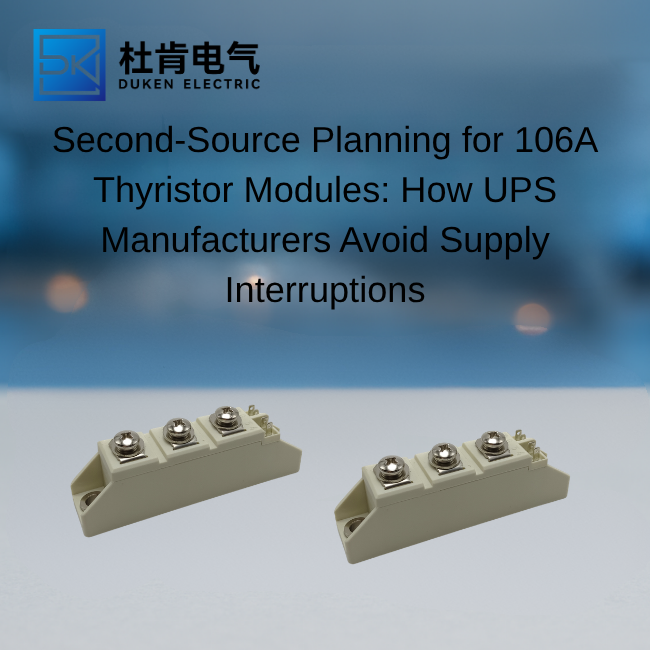
Second-Source Planning for 106A Thyristor Modules: How UPS Manufacturers Avoid Supply Interruptions
For OEM purchasing teams, delivery times and stock availability for thyristor modules are not only short-term logistics concerns. They are part of long-term component risk management. A UPS manufacturer may approve a 106A thyristor module based on electrical performance, only to discover several years later that lead times have increased, minimum order quantities have changed, or the original model has become difficult to source. At that point, finding a replacement under production pressure can be costly.
Why Second-Source Qualification Should Begin Before Stock Runs Out
Many industrial companies begin searching for an alternative semiconductor only after receiving a difficult message from their existing supplier: stock is unavailable, delivery has moved from weeks to months, or the model is approaching discontinuation.
This creates an engineering problem and a commercial problem at the same time.
Purchasing wants a fast replacement because production needs to continue. Engineering wants enough time to verify that the new module will not create reliability problems. The supplier wants an order quickly, particularly if materials need to be reserved.
These priorities can conflict.
A pre-qualified second source changes the situation. Instead of searching from zero during a shortage, the buyer already has an alternative that has been evaluated against the original design requirements.
This does not necessarily mean purchasing equal quantities from two suppliers every month. The second source can remain an approved backup, receive occasional orders, or support additional demand when the primary supplier cannot meet the required schedule.
The first step is identifying which components actually need second-source protection.
A common, widely available module with several compatible manufacturers may present relatively low supply risk. A specialized module with a particular package, topology, gate characteristic, or cooling arrangement deserves more attention.
A certified full-module hard-soldered-joints 106A thyristor module for UPS systems, for example, may be selected not only for its nominal current rating but also for its internal construction and long-term thermal-cycle performance. Finding another product marked “106A” is therefore not enough.
Historical consumption also matters.
If an OEM uses 2,000 modules per year, a supply interruption has a different impact from a spare part used five times per year. However, low-volume parts should not automatically be ignored. A low-volume module installed in a critical legacy UPS can still cause expensive downtime if no replacement is available.
Supply risk should therefore combine usage volume, replacement difficulty, expected lead time, and the consequence of shortage.
Technical Equivalence Requires More Than Matching 106A
Second-source qualification starts with the circuit rather than the supplier's product title.
The replacement needs the correct internal topology.
For AC power control, a water-cooling anti-parallel phase-control 106A thyristor module for UPS systems may use two SCRs connected in opposite directions so that controlled conduction can occur during both AC half-cycles.
A module containing two thyristors in another configuration may have identical current and voltage labels but cannot necessarily replace it.
The repetitive blocking-voltage rating must also be appropriate for the circuit.
Procurement teams sometimes focus heavily on current because “106A” appears prominently in the model description. In actual power electronics, voltage margin can be equally important. Transients, line conditions, and circuit topology influence the voltage experienced by the semiconductor.
Current rating itself must be interpreted using datasheet conditions.
A thyristor rated at 106A is not guaranteed to carry 106A continuously under every cooling condition. Case temperature, conduction angle, waveform, thermal resistance, and junction-temperature limits influence usable current.
On-state voltage deserves attention because it directly affects conduction loss.
A simplified estimate is:
Pcond ≈ VT × IT(avg)
If two modules have different on-state characteristics, they can produce different amounts of heat even when carrying the same load.
Thermal resistance then influences the resulting junction temperature:
Tj = Tc + P × Rth(j-c)
These equations are simplified, but they show why a replacement cannot be approved from nominal current alone.
Surge capability is another important parameter for UPS power stages. Abnormal current conditions, charging events, and faults can expose thyristors to short-duration current significantly above normal operating levels. ITSM should therefore be compared under the relevant datasheet test conditions.
Gate requirements complete another part of the electrical comparison.
A conventional SCR turns on after receiving an appropriate gate trigger and remains conducting until current falls below the required holding condition or the circuit commutates it off. The existing gate-control circuit must therefore provide reliable triggering for the alternative module.
The replacement review should include IGT and VGT where relevant, together with latching and holding behavior and the application's gate-drive design.
This is fundamentally different from selecting an IGBT. An IGBT provides gate-controlled turn-on and turn-off and is normally used where active high-frequency PWM is required. The SCR remains particularly effective for controlled rectification and phase-control functions.
Construction and Cooling Need Application-Level Verification
Electrical parameters are only one part of second-source approval.
For a certified full-module hard-soldered-joints 106A thyristor module for UPS systems, buyers should also consider whether the alternative supplier can maintain consistent module construction across production batches.
Power modules experience repeated temperature changes during service. The semiconductor junction heats under load and cools when loading decreases or the equipment stops. This creates thermal cycling within the module.
Internal construction and joining processes therefore influence long-term reliability.
The phrase “hard-soldered joints” should not simply be copied from a product description and treated as proof of quality. Buyers should understand what construction is being supplied and whether production controls and quality documentation support repeatability.
Certification needs the same disciplined approach.
An ISO-certified quality system, for example, describes a different form of assurance from a product-specific safety or conformity certification. Procurement specifications should state which documentation is actually required.
Water-cooled systems introduce additional qualification work.
A water-cooling anti-parallel phase-control 106A thyristor module for UPS systems may operate successfully on one cooling assembly but behave differently on another.
The module's losses, junction-to-case thermal resistance, thermal-interface condition, cooling-plate design, coolant temperature, and flow all contribute to the operating junction temperature.
When evaluating a second source, engineers should therefore reproduce representative thermal conditions as closely as practical.
A short no-load startup is insufficient.
The UPS should be operated under a meaningful load so that engineers can observe whether the alternative module develops unexpected temperature rise or triggering behavior.
Mechanical compatibility should be verified at the same stage.
Baseplate dimensions, mounting-hole locations, terminal positions, terminal size, gate connections, and overall height can determine whether the module fits without modifying the UPS assembly.
This is where an apparently inexpensive alternative can become costly.
If a module saves $10 per piece but requires a new busbar, redesigned cooling plate, modified gate wiring, and additional assembly work, the total replacement cost may exceed the saving.
Stock Agreements Can Be More Valuable Than Large Buyer-Owned Inventories
Once a second source is technically approved, procurement needs to decide how availability will be maintained.
Holding large quantities in the buyer's own warehouse is one option, but it is not always the most efficient.
Inventory ties up working capital and creates aging risk. Demand can change if a UPS model is redesigned or discontinued. A large safety stock purchased today may become slow-moving inventory several years later.
Supplier-side inventory planning can provide an alternative.
For recurring requirements, the buyer can communicate expected consumption so the supplier can plan finished modules or critical production materials. The exact arrangement depends on volume, predictability, and commercial agreements.
The important point is that delivery times and stock availability for thyristor modules should be discussed as measurable supply parameters.
Buyers can ask how many finished pieces are normally stocked, what materials are routinely maintained, what the normal production lead time is, and how quickly larger quantities can be replenished.
This is more useful than receiving a simple “stock available” answer.
Consider an OEM requiring 600 modules.
Supplier A has 600 pieces available today but normally produces the model only occasionally. Supplier B has 150 finished pieces and a stable production process capable of replenishing the balance on a predictable schedule.
For a one-time emergency order, Supplier A may be attractive.
For a five-year UPS production program, Supplier B's repeatable replenishment model may provide lower long-term risk.
Partial deliveries can also improve supply continuity.
If the buyer needs 300 pieces and 100 are finished, those 100 can potentially support immediate production while the remaining quantity is manufactured. The commercial value of this approach depends on freight costs and production priorities, but it provides another way to manage shortages without lowering technical standards.
Long-Term Availability Should Be Part of the Initial Module Selection
Component availability is easiest to manage when it is considered during UPS design rather than after production begins.
Engineering teams naturally focus on voltage, current, thermal performance, topology, reliability, and cost. Procurement should add lifecycle and sourcing questions to that process.
Is the module based on a common industrial package?
Are alternative manufacturers available?
Does the circuit use an unusual topology?
Could a compatible replacement be qualified without redesigning the cooling system?
How stable is demand for this current and voltage class?
These questions influence future maintenance and production risk.
Technology trends should also be considered realistically.
IGBT and SiC devices continue to expand in high-frequency power conversion, but this does not mean thyristor modules are becoming irrelevant. SCRs remain technically attractive in applications where high current, surge robustness, controlled rectification, and line-frequency phase control are important.
A mature technology can actually offer a supply-chain advantage when multiple manufacturers continue to support standardized industrial configurations.
However, older proprietary packages can become increasingly difficult to replace even when the semiconductor technology itself remains widely available.
For this reason, long-term UPS designs benefit from module selections that combine appropriate electrical performance with practical sourcing flexibility.
This is also why second-source qualification should not be viewed as an attempt to replace the original supplier.
It is a form of supply-chain engineering.
The objective is to ensure that production does not depend completely on one model, one production line, or one inventory position when technically acceptable alternatives exist.
Conclusion
For UPS manufacturers, managing delivery times and stock availability for thyristor modules requires coordination between engineering and procurement. The purchasing team cannot solve a shortage safely without understanding topology, voltage, current, gate requirements, surge capability, thermal performance, and mechanical compatibility. Engineering, meanwhile, cannot protect production continuity without considering lead time, stock strategy, and alternative sources.
A 106A second source should therefore be qualified before it becomes urgently necessary. Hard-soldered construction, certification requirements, anti-parallel topology, and water-cooling performance should all be evaluated according to the actual UPS application rather than relying on nominal current alone.
Once the technical alternative is approved, forecasts, supplier-side inventory, partial shipments, and appropriate safety stock can provide additional protection.
The strongest supply strategy is not the one that keeps the largest warehouse. It is the one that combines a technically validated second source with predictable replenishment, allowing the correct thyristor module to remain available throughout the production and service life of the UPS system.
FAQ
Q1: When should an OEM qualify a second source for a thyristor module?
Ideally, qualification should occur while the primary component is still readily available. This gives engineering enough time to complete electrical, thermal, and mechanical evaluation without production pressure.
Q2: Is matching 106A and the voltage rating enough for second-source approval?
No. Topology, gate characteristics, on-state voltage, surge current, thermal resistance, dimensions, terminals, mounting requirements, and cooling compatibility should also be reviewed.
Q3: Should UPS manufacturers keep all critical thyristor modules in their own warehouse?
Not necessarily. Buyer-held safety stock, supplier-held inventory, material planning, forecasts, and scheduled deliveries can be combined according to consumption and supply risk.
Q4: Why does hard-soldered construction matter for long-term supply qualification?
Power modules experience electrical loading and thermal cycling. Internal joining quality and manufacturing consistency can therefore influence long-term reliability across repeated production batches.
Q5: Will IGBT or SiC modules eliminate the need for SCR modules in UPS systems?
Not universally. IGBT and SiC technologies are strong choices for high-frequency switching, while SCRs remain effective for high-current controlled rectification and phase-control functions.
READ MORE:
Pre-Shipment Testing and Technical Support for 106A Thyristor Modules in UPS Projects
Repeated Thyristor Module Failures in UPS Systems: A Root-Cause Analysis Guide
Thermal Troubleshooting of 106A Thyristor Modules: Why UPS Power Modules Overheat
Gate Trigger Troubleshooting for 106A Thyristor Modules in UPS Phase-Control Systems
Emergency Thyristor Module Sourcing for UPS Repairs: Balancing Fast Delivery and Technical Risk
Why Thyristor Module Stock Changes: Lead-Time Planning for 106A UPS Power Systems
Thyristor Module Delivery Times and Stock Availability: A Procurement Guide for UPS Manufacturers