
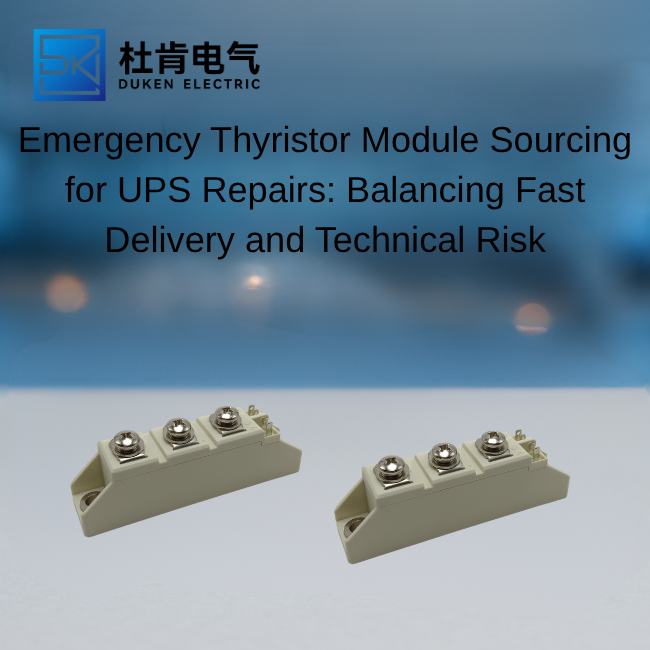
Emergency Thyristor Module Sourcing for UPS Repairs: Balancing Fast Delivery and Technical Risk
When a UPS rectifier or power-control section fails, delivery times and stock availability for thyristor modules immediately become a maintenance issue rather than a routine purchasing question. An OEM planning next month's production may tolerate a normal manufacturing lead time, but a maintenance company dealing with an offline UPS may need the correct module within days. This urgency creates a common sourcing risk: selecting a device because it is available rather than because it is technically compatible.
The problem becomes more complex with specialized configurations such as a certified full-module hard-soldered-joints 106A thyristor module for UPS systems or a water-cooling anti-parallel phase-control 106A thyristor module for UPS systems. Current rating alone cannot determine interchangeability. For emergency replacement, buyers need a faster qualification process, but they still need to verify the parameters that determine whether the module will survive after installation.
Why Emergency UPS Repairs Create a Different Procurement Problem
UPS systems are designed to protect critical loads, so downtime can have consequences far beyond the cost of the failed semiconductor. Data infrastructure, industrial control systems, telecommunications equipment, medical facilities, and production lines may all depend on reliable backup power.
When a power semiconductor fails, the maintenance team usually begins with the original part number. If that model is still available from stock, procurement is relatively straightforward. Problems begin when the original device has a long lead time, has become difficult to source, or is no longer manufactured.
At this point, buyers often search by current and voltage.
For a repair project, mechanical compatibility is particularly important. An OEM designing a new UPS can modify a busbar, heat sink, control board, or enclosure. A maintenance engineer repairing installed equipment usually cannot.
The replacement may need to fit the existing mounting holes, connect to the existing busbars, work with the existing gate-drive circuit, and operate correctly with the original cooling system.
This means the fastest supplier is not necessarily the supplier offering the shortest total repair time.
If an immediately available module requires mechanical modification or gate-drive redesign, a technically compatible product with a slightly longer shipping time may actually restore the UPS sooner.
Buyers should therefore consider total replacement time rather than shipment time alone.
What Must Be Confirmed Before Using an Available 106A Replacement
The first step in emergency sourcing is to determine the circuit configuration.
A water-cooling anti-parallel phase-control 106A thyristor module for UPS systems, for example, uses two SCRs arranged to control opposite directions of an AC waveform. A dual-thyristor module with another topology may have the same current and voltage ratings while performing a different electrical function.
The internal circuit diagram should therefore be checked before dimensional similarity is considered sufficient.
Voltage rating comes next.
The replacement's repetitive blocking capability must meet the circuit requirement with suitable engineering margin. Selecting a lower voltage class simply because it is available from stock can expose the semiconductor to repetitive electrical stress.
The 106A current rating also requires interpretation.
Power semiconductor current ratings are defined under particular operating and thermal conditions. A nominal 106A module should not be interpreted as a component that can carry exactly 106A continuously in every UPS installation.
Conduction angle, current waveform, case temperature, cooling method, thermal-interface quality, and junction-temperature limit all influence actual operating capability.
On-state voltage is especially relevant because it contributes to conduction loss. A simplified approximation is:
Pcond ≈ VT × IT(avg)
A replacement with a higher on-state voltage can generate more heat at the same current.
Thermal resistance must therefore be considered together with electrical loss. A simplified thermal relationship is:
Tj = Tc + P × Rth(j-c)
For emergency replacement, engineers do not necessarily need to recreate every qualification test used during original UPS development. They do, however, need enough information to determine whether the new module will operate within a safe thermal range.
Gate parameters are another frequently overlooked area.
A conventional SCR is triggered into conduction through its gate. Once latched, removing the gate signal does not normally turn it off; current must fall below the necessary holding condition or be commutated by the external circuit.
The existing gate driver must therefore be capable of reliably triggering the replacement thyristor under the intended operating conditions.
A module that physically fits but requires substantially different gate triggering may create intermittent firing or abnormal phase control.
Hard-Soldered Construction Matters Beyond the First Successful Startup
An emergency repair often creates a dangerous psychological checkpoint: if the UPS starts successfully after replacement, everyone assumes the problem is solved.
Startup proves only part of the replacement.
Long-term operation subjects power modules to repeated electrical and thermal loading. Junction temperature rises when the device conducts and falls as load conditions change. Over time, these temperature cycles place mechanical stress on internal materials and joints.
This is why construction quality matters.
When sourcing a certified full-module hard-soldered-joints 106A thyristor module for UPS systems, buyers should evaluate manufacturing consistency rather than treating “hard-soldered” as a decorative product description.
Internal joints contribute to the electrical and thermal path between the semiconductor and module structure. Their quality can affect long-term reliability under thermal cycling.
For industrial maintenance companies, this becomes especially important when the repaired UPS is expected to return to continuous service for years rather than operate temporarily until another unit is installed.
Certification should also be interpreted accurately.
Buyers should determine whether the available documentation refers to the manufacturing quality system, factory, product family, or exact product. Different documents provide different types of assurance.
For an urgent MRO order, there may not be time for a lengthy supplier audit. A practical alternative is to request technical documentation, actual product photographs, electrical test information where appropriate, and confirmation of product identity before shipment.
This creates a basic technical record that can also support future repeat orders.
Water-Cooled UPS Systems Need Thermal Compatibility, Not Simply Higher Current
Water cooling can make high-power UPS equipment compact and thermally efficient, but it does not eliminate the need to evaluate semiconductor losses.
A water-cooling anti-parallel phase-control 106A thyristor module for UPS systems transfers heat from the semiconductor through the package and thermal interface into the cooling assembly.
The performance of this path depends on more than the coolant.
The module's internal thermal resistance, baseplate construction, interface quality, coolant inlet temperature, flow conditions, and cooling-channel design all contribute to the final junction temperature.
This matters when comparing an original module with an available alternative.
Suppose both are rated at 106A, but the replacement has different on-state characteristics. The replacement may dissipate more heat at the same load. Even though the water-cooling system remains unchanged, semiconductor junction temperature may increase.
For a short emergency test, the difference may not be obvious.
The UPS may start, run for several minutes, and appear completely normal. As the system approaches thermal equilibrium under sustained load, the replacement may operate at a different temperature from the original.
For critical repairs, a controlled load test should therefore extend beyond basic startup.
Engineers should observe operation under representative load and confirm that there is no abnormal temperature rise, unstable triggering, unusual noise, or unexpected waveform behavior.
Installation quality must also be controlled. The mounting surface should be suitable for the module, and the manufacturer's specified installation requirements should be followed rather than assuming that the original module's mounting instructions automatically apply to the replacement.
This is one reason a mechanically similar stock item should not be approved only from photographs.
Building an Emergency Stock Strategy for Future UPS Failures
The best emergency sourcing strategy begins after the previous emergency has been solved.
Once a maintenance company identifies a frequently used 106A module, it can record the original model, voltage class, topology, package dimensions, gate requirements, thermal parameters, and approved alternatives.
This creates a replacement database for future repairs.
Distributors can use the same principle.
Rather than stocking many visually similar thyristor modules, they can identify configurations that serve a broad installed base and maintain reasonable quantities of those models.
For specialized products, supplier availability can provide the second layer of inventory protection. The distributor may hold a small local quantity while the manufacturer maintains finished or semi-finished stock for replenishment.
For OEMs, the strategy can be more systematic. Critical components can be classified according to normal delivery times and stock availability for thyristor modules, annual usage, second-source availability, and the operational cost of a shortage.
A module with a long replenishment time and no qualified alternative deserves more safety stock than a common module available from several approved sources.
This approach also helps when products approach the end of their commercial life.
If an older UPS platform continues to require spare parts, the manufacturer can evaluate whether to make a last-time purchase, qualify a replacement module, or redesign the service solution before the original component becomes impossible to obtain.
Technology alternatives should be considered carefully.
An IGBT module is not automatically a replacement for a thyristor module. IGBTs support gate-controlled turn-on and turn-off and are suitable for high-frequency PWM, while SCRs are particularly effective in line-frequency controlled rectification and phase-control functions.
SiC power devices offer major advantages in high-frequency switching applications but similarly do not represent universal drop-in replacements for SCR phase-control circuits.
For emergency maintenance, redesigning the converter around another semiconductor technology is usually a very different project from replacing the failed module.
A qualified SCR alternative with compatible electrical, thermal, and mechanical characteristics is generally the more practical route when the objective is restoring existing equipment.
Conclusion
In an emergency UPS repair, delivery times and stock availability for thyristor modules can determine how quickly critical equipment returns to service. But shipment speed should never replace basic engineering qualification.
For a 106A replacement, buyers need to verify topology, voltage class, current capability, gate characteristics, on-state performance, surge capability, thermal resistance, package dimensions, and mounting compatibility. Hard-soldered construction and appropriate certification documentation can provide additional information when long-term reliability matters, while water-cooled applications require careful attention to the complete thermal path.
The most effective long-term solution is to convert emergency purchasing experience into future supply planning. Recording approved alternatives, maintaining strategic spare stock, understanding supplier replenishment times, and qualifying second sources can substantially reduce the risk associated with the next failure.
For industrial UPS manufacturers, maintenance companies, and distributors, the objective is therefore not simply to find a 106A thyristor module that can ship today. It is to find a technically correct module that can be installed quickly, operate reliably, and remain available when the next requirement appears.
FAQ
Q1: What should be checked first when replacing an unavailable 106A thyristor module?
Start with the internal circuit configuration, voltage class, current rating conditions, gate parameters, dimensions, and terminal arrangement before considering it a compatible replacement.
Q2: Is a higher-current thyristor module automatically a safer replacement?
No. Higher nominal current does not guarantee compatible topology, gate behavior, voltage capability, thermal characteristics, dimensions, or mounting requirements.
Q3: Why should a water-cooled replacement be tested under sustained load?
Short startup tests may not reveal the final thermal behavior. Sustained operation allows the semiconductor and cooling system to approach more representative operating temperatures.
Q4: Can an IGBT module replace an unavailable SCR module?
Usually not as a direct replacement. IGBTs and SCRs use different control principles and are typically applied differently within power-conversion circuits.
Q5: How can UPS repair companies reduce future emergency sourcing problems?
Maintain records of approved replacements, keep strategic stock of critical modules, understand supplier replenishment times, and qualify alternative sources before the original device becomes unavailable.
READ MORE:
Pre-Shipment Testing and Technical Support for 106A Thyristor Modules in UPS Projects
Repeated Thyristor Module Failures in UPS Systems: A Root-Cause Analysis Guide
Thermal Troubleshooting of 106A Thyristor Modules: Why UPS Power Modules Overheat
Gate Trigger Troubleshooting for 106A Thyristor Modules in UPS Phase-Control Systems
Second-Source Planning for 106A Thyristor Modules: How UPS Manufacturers Avoid Supply Interruptions
Why Thyristor Module Stock Changes: Lead-Time Planning for 106A UPS Power Systems
Thyristor Module Delivery Times and Stock Availability: A Procurement Guide for UPS Manufacturers