
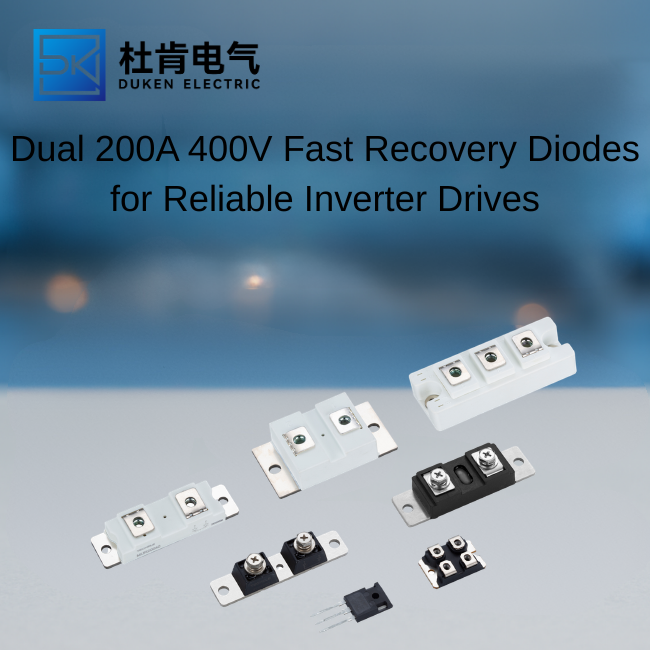
Dual 200A 400V Fast Recovery Diodes for Reliable Inverter Drives
Author: Selina
A 200A 400V fast recovery diode used in an inverter drive must handle high current, rapid commutation, and repeated thermal cycling without disrupting motor control. Dual-diode construction can reduce assembly complexity and shorten current paths, but only when recovery behavior, polarity, cooling, and surge ratings match the inverter topology. For industrial OEMs and distributors, evaluating these details is essential before approving a replacement or new source.
The Role of Fast Recovery Diodes in Inverter Drives
Inverter drives convert DC power into controlled AC output for motors, pumps, compressors, conveyors, and machine tools. IGBTs or MOSFETs switch the DC bus at high speed, while freewheeling diodes provide a path for inductive motor current when the switches turn off.
Because motor windings store energy, current cannot stop instantly. The diode must conduct this current and then recover quickly when the opposite switch turns on. Excessive reverse recovery current increases turn-on loss in the transistor, raises junction temperature, and can produce damaging voltage overshoot.
Why Recovery Softness Matters
Recovery time alone does not fully describe switching behavior. A diode may recover quickly but abruptly, creating a high di/dt event and strong electromagnetic noise. A softer recovery characteristic reduces current ringing and eases stress on the IGBT, snubber, and insulation system.
Engineers should therefore review reverse recovery charge, peak recovery current, recovery slope, and the test conditions used in the datasheet.
Critical Electrical and Thermal Parameters
| Parameter | Why It Matters |
|---|---|
| Average forward current | Must match real RMS and duty-cycle conditions |
| Repetitive reverse voltage | Needs margin above DC-bus transients |
| Reverse recovery charge | Directly affects transistor turn-on loss |
| Forward voltage | Determines conduction loss during freewheeling |
| Surge forward current | Supports startup, braking, and fault events |
| Junction temperature | Sets thermal operating limit |
| Thermal resistance | Controls heatsink and interface requirements |
| Polarity and package | Must fit the bridge topology and busbar layout |
Forward Current Is Not a Standalone Rating
The 200A designation normally applies under specified case-temperature conditions. Inverter duty may produce high RMS current even when average current appears moderate. Engineers should calculate actual conduction intervals, modulation pattern, motor power factor, overload duration, and ambient temperature.
The diode should be derated when it shares a heatsink with IGBTs or operates inside a sealed cabinet. Thermal coupling from nearby components can raise case temperature and reduce current capability.
Reverse Voltage and DC-Bus Margin
A 400V diode requires careful use in inverter drives. The peak reverse voltage includes the DC bus plus switching overshoot caused by stray inductance. Long busbars, poor snubber placement, and fast transistor edges can raise this peak considerably.
Buyers should not assume that a 400V-rated device is suitable for a nominal 400V bus. The correct choice depends on measured waveforms, application standards, and required safety margin.
Dual-Diode Packaging and System Benefits
Dual devices can save space and simplify assembly by integrating two matched diode chips. Fewer external joints may reduce resistance and improve repeatability. A common mounting structure can also improve thermal symmetry between the two current paths.
However, the integrated package introduces shared thermal behavior. If one diode conducts more frequently, heat can influence the second device. The heatsink design must therefore account for total package dissipation rather than treating each junction independently.
Important mechanical checks include terminal spacing, creepage distance, stud or base dimensions, mounting torque, insulation method, and busbar alignment. A mechanically similar component may still have different internal polarity or thermal resistance.
Comparison with Other Diode Options
Dual Fast Recovery Diode vs Standard Rectifier
A standard silicon rectifier is optimized for low-frequency conversion and may have excessive stored charge in a PWM inverter. It can increase IGBT turn-on current and generate additional heat. A fast recovery diode is generally preferred for industrial drives operating at several kilohertz or higher.
Discrete Dual Diode vs IGBT Module Co-Pack Diode
Many IGBT modules include an antiparallel diode. This simplifies assembly and ensures close electrical matching. A separate dual diode may still be useful in custom bridge circuits, braking units, auxiliary paths, or replacement designs where independent thermal sizing is required.
The decision should consider current sharing, layout inductance, serviceability, and supply continuity. Separate diodes can provide sourcing flexibility but may increase assembly work.
Fast Recovery Silicon vs SiC
SiC diodes offer extremely low reverse recovery and excellent high-temperature performance. They can reduce switching loss in high-frequency drives. Their higher purchase cost and different surge behavior, however, may not be justified in every industrial design.
A silicon 200A 400V fast recovery diode remains competitive where switching frequency is moderate, surge robustness is important, and existing cooling or mounting structures must be retained.
Application-Specific Selection Guidance
For pumps and fans, continuous operation and thermal efficiency are primary concerns. For cranes, presses, and conveyors, repetitive acceleration and regenerative events create higher transient stress. Machine-tool spindles may prioritize switching performance and low torque ripple, while mining and mobile equipment require stronger vibration and surge tolerance.
Procurement teams should provide the supplier with bus voltage, switching frequency, motor current, overload profile, cooling method, package constraints, and required polarity. Without this information, a quotation based only on “200A 400V” can be technically misleading.
Prototype validation should include maximum-load temperature measurement, repeated acceleration and deceleration, locked-rotor or overload tests where safe, high-line input, and post-test leakage checks. Oscilloscope measurements should capture diode current, transistor voltage, and recovery transients.
Supplier Qualification for High Reliability
Reliable inverter production depends on consistent semiconductor characteristics across batches. Buyers should request traceability, wafer or die-change notification, outgoing electrical test criteria, package drawings, and reliability data.
For distributors, it is important to confirm storage conditions, moisture protection where applicable, terminal finish, date-code control, and counterfeit prevention procedures. A low-cost part with uncertain origin can expose the equipment manufacturer to far higher warranty and downtime costs.
Conclusion
Dual fast recovery diodes can improve inverter-drive integration, but the correct device must be selected from complete electrical, thermal, and mechanical data. A high-quality 200A 400V fast recovery diode should provide low recovery charge, controlled softness, adequate surge capability, suitable forward voltage, and stable thermal performance. Testing the device in the actual inverter under realistic motor cycles is the strongest basis for a reliable sourcing decision.
Frequently Asked Questions
Why use a dual diode in an inverter drive?
It can reduce component count, shorten current paths, and provide matched thermal behavior in bridge or freewheeling circuits.
Is a lower reverse recovery time always better?
Not by itself. Recovery charge, peak current, softness, and test conditions must also be considered.
Can a 200A diode carry 200A continuously?
Only under the specified cooling and case-temperature conditions. Real inverter duty often requires derating.
When should a SiC diode be selected?
SiC is attractive at high switching frequencies or when efficiency gains justify the higher component cost.
What data should a buyer send to the supplier?
Provide bus voltage, switching frequency, current waveform, overload profile, cooling method, package dimensions, and polarity.
SEO Keywords: 200A 400V fast recovery diode, dual diode for inverter drives, high reliability power diode, inverter freewheeling diode, dual fast recovery diode, industrial motor drive diode, IGBT inverter diode, MOSFET inverter diode, low recovery charge diode, soft recovery diode, high current inverter rectifier, 200 amp power diode, 400 volt fast diode, inverter drive components, motor control semiconductor, surge current diode, low forward voltage diode, common anode dual diode, common cathode dual diode, industrial rectifier supplier, OEM inverter manufacturer, motor drive distributor, semiconductor sourcing, diode thermal design, inverter busbar design, switching loss reduction, reverse recovery charge, power electronics components, high current semiconductor, industrial automation diode, pump drive components, conveyor inverter components, crane drive rectifier, spindle drive diode, braking unit diode, IGBT module comparison, SiC diode comparison, inverter qualification testing, diode traceability, power semiconductor supplier
READ MORE:
A Procurement Guide to Qualifying a 200A 400V Fast Recovery Diode Supplier
How Dual 200A 400V Fast Recovery Diodes Improve Inverter Drive Reliability
Procurement Guide to Replacing 200A 400V Fast Recovery Diodes
Why Common-Anode 200A 400V Fast Recovery Diodes Matter in Welding Machines
How to Evaluate 200A 400V Fast Recovery Diodes for High-Surge Duty
How to Select a 3/4-16UNF Stud Type 200A 400V Fast Recovery Diode for Automotive Power Systems
Common-Anode 200A 400V Fast Recovery Diodes for Welding Machines
What Does Soft Recovery Mean in a 200A 400V Fast Recovery Diode?
200A 400V Fast Recovery Diode for High-Surge Automotive Power Systems