
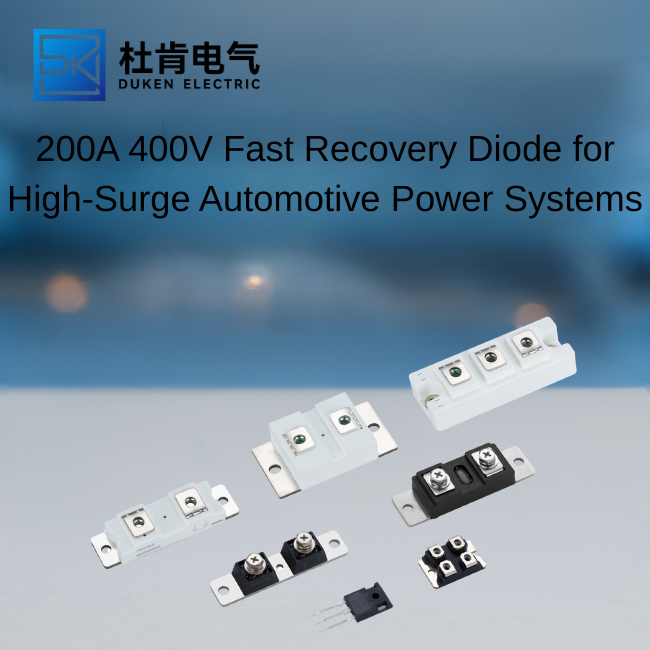
200A 400V Fast Recovery Diode for High-Surge Automotive Power Systems
Author: Selina
Industrial vehicle electronics, welding equipment, charging systems, and high-current power converters require rectifiers that can tolerate repeated surge events without sacrificing switching efficiency. A 200A 400V fast recovery diode provides the current capacity, reverse-voltage margin, and recovery performance needed in demanding applications where ordinary rectifier diodes may overheat or fail prematurely. For automotive and mobile equipment manufacturers, a stud-mounted package also simplifies mechanical installation, heat transfer, and field replacement.
Why High-Surge Applications Require a Specialized Diode
These surge conditions are common in:
Automotive alternator and charging systems
Battery-powered industrial vehicles
Welding machine rectifier stages
Motor drives and inverter systems
High-current DC power supplies
Generator excitation circuits
Heavy-duty converters
A standard rectifier may have sufficient average current capacity but inadequate surge-current capability. Repeated electrical stress can increase junction temperature, accelerate bond degradation, and eventually cause short-circuit or open-circuit failure.
A properly selected 200A 400V fast recovery diode combines a high forward-current rating with a low reverse recovery time. This reduces switching losses while maintaining sufficient current headroom for transient operating conditions.
Understanding Reverse Recovery
When a diode changes from forward conduction to reverse blocking, stored charge must be removed from the semiconductor junction. During this short interval, reverse current continues to flow.
The reverse recovery time, commonly specified as trr, directly influences switching losses, junction heating, electromagnetic interference, voltage overshoot, and stress on switching devices.
In systems using IGBTs or MOSFETs, a slow diode can increase switching stress and reduce overall converter efficiency. A fast recovery device limits stored charge and allows the circuit to transition more quickly between conduction and blocking states.
Benefits of a 3/4″-16UNF Stud Type Package
A 3/4″-16UNF stud type fast recovery diode is designed for high-current equipment where both electrical performance and thermal management are critical. The threaded stud creates a direct mechanical connection to a heatsink or conductive bus structure.
Efficient Heat Transfer
The metal stud provides a short thermal path from the semiconductor junction to the heatsink. When installed with the correct mounting torque and thermal interface material, the package can dissipate heat more effectively than many compact plastic packages.
Improved thermal performance helps maintain a lower junction temperature, extend component service life, reduce thermal cycling stress, support higher continuous current, and improve reliability under intermittent overloads.
Strong Mechanical Stability
Industrial vehicles, welding machines, and mobile power equipment are exposed to vibration and mechanical shock. A threaded mounting system provides greater mechanical security than a loosely clamped component.
For automotive applications, the mounting surface should be flat, clean, and free from oxidation. Excessive mounting torque must be avoided because it can damage the stud, distort the package, or create internal mechanical stress.
Simplified Polarity Configuration
Stud-type diodes are available in different polarity arrangements. In a common-anode configuration, the anode terminals of two diode elements share a common electrical connection. This arrangement can simplify the layout of specific rectifier assemblies and reduce the number of external interconnections.
Procurement teams should confirm polarity before ordering. Two diodes with identical current and voltage ratings may not be interchangeable if their stud polarity, terminal arrangement, or internal configuration differs.
Key Parameters for Selecting a 200A 400V Diode
Purchasing a diode based only on the “200A” and “400V” markings can lead to field failures. Engineers should evaluate the complete operating profile of the application.
| Parameter | Typical Selection Consideration |
|---|---|
| Average forward current | 200A under specified cooling conditions |
| Repetitive peak reverse voltage | 400V minimum |
| Surge forward current | Must exceed startup and fault transients |
| Forward voltage drop | Lower values reduce conduction losses |
| Reverse recovery time | Selected according to switching frequency |
| Junction temperature | Must remain below the rated maximum |
| Package type | 3/4″-16UNF stud mount |
| Polarity | Common anode, common cathode, or standard polarity |
| Thermal resistance | Evaluated with the intended heatsink |
| Isolation requirement | Determined by circuit and mounting design |
Current Rating and Cooling Conditions
The rated forward current is normally measured under specific case-temperature or heatsink conditions. A diode marked 200A may not safely conduct 200A continuously if cooling is inadequate.
Engineers should calculate conduction losses using the expected forward voltage:
Conduction loss ≈ Forward voltage × Average forward current
For example, a diode with a 1.2V forward drop at 150A may dissipate approximately 180W during conduction. This heat must be transferred through the package, mounting interface, and heatsink.
Reverse-Voltage Margin
A 400V reverse-voltage rating should not be used in a circuit that repeatedly approaches 400V during normal operation. Inductive switching, cable impedance, and transformer leakage can create voltage spikes above the nominal DC bus level.
A suitable design margin depends on DC bus voltage, switching topology, snubber circuit performance, load inductance, operating temperature, and expected line transients.
For unstable or highly inductive systems, engineers may need a higher-voltage diode even when the nominal circuit voltage appears compatible with a 400V device.
Surge-Current Capability
Surge-current ratings are usually specified for a defined waveform and duration, such as an 8.3ms half-sine pulse. This value should not be interpreted as a continuous current rating.
For welding equipment and engine-driven systems, surge events may occur frequently. In these applications, repetitive surge capability and thermal recovery time are more important than a single non-repetitive surge figure.
Automotive and Industrial Application Analysis
A 3/4″-16UNF stud type fast recovery diode is well suited to high-current automotive and mobile industrial systems because it combines rugged mounting with efficient heat dissipation.
In alternator-related rectification, the diode must tolerate temperature variation, vibration, reverse-voltage spikes, and fluctuating load current. In battery charging systems, it must handle inrush current and changing battery impedance. In DC motor systems, the diode may also provide a freewheeling path for inductive current.
The same device class can be used in welding machines, where high secondary current and rapid load transitions create severe electrical and thermal stress. Low forward voltage is especially valuable because even a small voltage reduction can significantly decrease power loss at 200A.
In inverter drives, a 200A 400V fast recovery diode may operate alongside an IGBT or MOSFET. Compared with a standard rectifier diode, the fast recovery device produces lower switching loss and less reverse recovery current. However, for very high switching frequencies, a SiC diode may provide even lower recovery losses, although at a higher component cost.
Comparison with Alternative Rectifier Technologies
Fast Recovery Diode vs Standard Rectifier Diode
A standard rectifier diode is suitable for low-frequency applications, including 50Hz or 60Hz power conversion. It is generally cost-effective but may produce excessive reverse recovery loss in PWM converters and inverter circuits.
A fast recovery diode is preferable when switching frequency is higher, reverse recovery heating is a concern, IGBT or MOSFET stress must be reduced, faster current commutation is required, or EMI performance needs improvement.
Fast Recovery Diode vs SiC Diode
SiC diodes offer very low reverse recovery charge and excellent high-temperature capability. They are widely used in high-efficiency converters, renewable energy systems, and advanced motor drives.
However, a silicon fast recovery diode may remain the better commercial choice when the switching frequency is moderate, initial component cost is important, a proven stud package is required, existing mechanical designs must be maintained, or surge-current robustness is the main priority.
The selection should be based on total system cost rather than the diode price alone.
Procurement and Qualification Recommendations
Before placing a production order, buyers should request a complete datasheet and confirm that the ratings apply to the intended operating conditions.
Important qualification points include forward-voltage test conditions, reverse recovery test conditions, surge-current waveform and duration, maximum junction temperature, thermal resistance values, stud polarity and terminal configuration, recommended mounting torque, traceability and date-code control, reliability testing procedures, and production consistency between batches.
Samples should be evaluated under realistic load cycles. A short bench test at room temperature cannot fully represent operation inside a sealed enclosure, vehicle engine compartment, or welding cabinet.
For long-term supply programs, procurement managers should also confirm factory capacity, change-notification procedures, packaging standards, and availability of electrical test reports.
Conclusion
Selecting the correct rectifier requires more than matching current and voltage values. A high-reliability 200A 400V fast recovery diode must provide suitable surge capability, low conduction loss, controlled reverse recovery, and an effective thermal path. For automotive, welding, and inverter applications, a stud-mounted design can deliver the mechanical strength and cooling performance required for dependable service. Verifying polarity, recovery characteristics, surge ratings, and mounting requirements before purchase reduces qualification risk and helps prevent costly field failures.
Frequently Asked Questions
1. Can a 200A diode operate continuously at 200A?
Only when the specified case temperature, heatsink, airflow, and mounting conditions are maintained. In many practical systems, the diode should be derated to keep the junction temperature within a safe range.
2. Why is low forward voltage important in high-current applications?
Forward-voltage loss is converted directly into heat. At 200A, even a 0.1V reduction can lower conduction loss by approximately 20W.
3. Is a 400V diode suitable for a 400V DC bus?
Usually not. The diode requires sufficient reverse-voltage margin for switching spikes, inductive transients, and line variation. A higher-voltage device may be necessary.
4. What information is needed to confirm stud-diode polarity?
Buyers should provide the circuit diagram, stud polarity requirement, terminal arrangement, and whether the assembly requires common-anode or common-cathode construction.
5. Can this diode replace a SiC diode?
It may replace a SiC diode in moderate-frequency systems where cost, surge capability, and mechanical compatibility are more important than near-zero reverse recovery. Electrical and thermal testing is required before substitution.
SEO Keywords: 200A 400V fast recovery diode, 3/4″-16UNF stud type fast recovery diode, automotive rectifier diode, high-surge current diode, stud mount power diode, common anode diode, low conduction loss diode, welding machine rectifier diode, inverter drive diode, high reliability power diode, industrial rectifier diode, 200 amp diode, 400 volt diode, fast switching rectifier, high current semiconductor diode, alternator rectifier diode, battery charger diode, motor drive freewheeling diode, high power silicon diode, threaded stud diode, power conversion diode, low forward voltage diode, reverse recovery diode, high current rectifier supplier, OEM diode manufacturer, industrial diode distributor, power semiconductor sourcing, diode selection support, rectifier diode customization, semiconductor technical support, welding equipment manufacturer, automotive electronics manufacturer, industrial inverter manufacturer, motor drive manufacturer, power supply manufacturer, electronic component distributor, industrial equipment procurement manager, power electronics engineer, automotive component buyer, semiconductor sourcing specialist
Tags: Fast Recovery Diode, 200A Diode, 400V Diode, Stud Type Diode, Automotive Rectifier, High Surge Diode, Common Anode Diode, Welding Machine Diode
READ MORE:
A Procurement Guide to Qualifying a 200A 400V Fast Recovery Diode Supplier
How Dual 200A 400V Fast Recovery Diodes Improve Inverter Drive Reliability
Procurement Guide to Replacing 200A 400V Fast Recovery Diodes
Why Common-Anode 200A 400V Fast Recovery Diodes Matter in Welding Machines
How to Evaluate 200A 400V Fast Recovery Diodes for High-Surge Duty
How to Select a 3/4-16UNF Stud Type 200A 400V Fast Recovery Diode for Automotive Power Systems
Dual 200A 400V Fast Recovery Diodes for Reliable Inverter Drives
Common-Anode 200A 400V Fast Recovery Diodes for Welding Machines
What Does Soft Recovery Mean in a 200A 400V Fast Recovery Diode?