
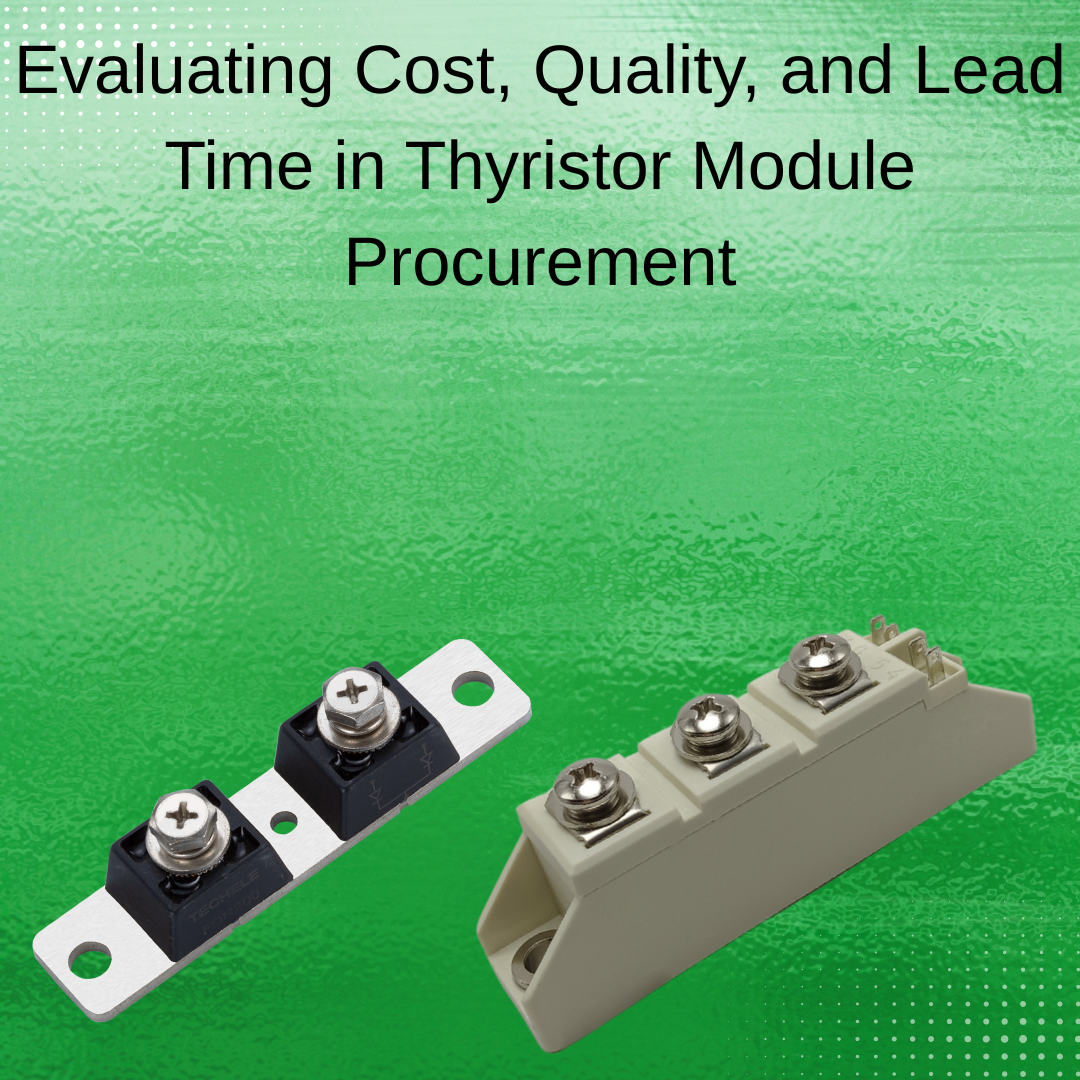
Evaluating Cost, Quality, and Lead Time in Thyristor Module Procurement
Effective procurement of high surge current low on‑state voltage industrial phase control dual thyristor modules requires more than comparing unit prices. For industrial UPS systems, a successful strategy must weigh three essential pillars: cost, quality, and lead time. This article provides a detailed framework to balance these factors and make informed sourcing decisions across diverse industrial applications such as desalination, automation, and energy control systems.
1. Cost Considerations Beyond the Price Tag
While unit price is a visible cost, hidden costs—such as customs duties, shipping, warehousing, and warranty support—can significantly affect total procurement expenses. Buyers must also factor in the cost of potential system failures due to unreliable modules.
The 250A desalination smart grid high surge current low on‑state voltage industrial phase control dual thyristor module may carry a premium price, but it often includes full testing certification, advanced heat dissipation design, and long-term warranty coverage. These features can reduce downstream maintenance costs and extend the system's operating life, delivering better ROI over time.
For mission-critical applications, paying more for a module with a consistent thermal profile and higher surge margin can offset the cost of emergency replacements or production halts.
2. Measuring and Ensuring Quality Standards
The 1.2V high frequency bottling high surge current low on‑state voltage industrial phase control dual thyristor module is commonly used in fast-cycling environments where switching accuracy and durability are key. When evaluating such modules, consider the supplier's quality systems, including:
ISO 9001 or ISO/TS 16949 certification
In-house testing labs or access to third-party verifications
Pass/fail criteria for VTM, thermal impedance, and gate triggering
Conformity to CE, RoHS, and WEEE directives
Additionally, inspect the packaging integrity, documentation quality, and batch-level testing data. Request a quality dossier for the power factor radar laser high surge current low on‑state voltage industrial phase control dual thyristor module, especially when sourcing from regions where counterfeiting is a known issue.
3. Managing Lead Time Expectations and Buffer Stocks
Lead time discrepancies can result from capacity constraints, raw material shortages, or logistics delays. Therefore, sourcing teams must set realistic expectations and buffer inventory accordingly.
Lead times for the 250A desalination smart grid high surge current low on‑state voltage industrial phase control dual thyristor module can range from 6 to 14 weeks, depending on order volume and supplier location. To manage this:
Build reorder schedules based on historical usage
Use safety stock modeling for long-lead items
Partner with distributors offering bonded or consignment inventory
Emergency air shipments or last-minute factory purchases can cost significantly more than planned stock replenishment.
4. Balancing the Cost-Quality-Lead Time Triangle
Achieving the optimal trade-off requires cross-functional collaboration. Engineering may prioritize quality and performance, while finance focuses on cost control, and operations emphasize timely delivery.
When selecting a supplier for the 1.2V high frequency bottling high surge current low on‑state voltage industrial phase control dual thyristor module, ask:
Is the price justified by life cycle performance and warranty?
Can the supplier guarantee delivery during our peak season?
Is the module electrically and thermally compatible with our system design?
For power factor radar laser modules, weigh premium costs against the risks of waveform distortion, thermal failure, or energy inefficiency in high-frequency applications.
5. Conclusion: Smart Procurement Is Strategic Procurement
The long-term success of UPS systems hinges on the quality and consistency of their core components. A well-structured procurement process that evaluates cost, quality, and lead time in tandem leads to better system uptime, fewer operational surprises, and improved bottom-line performance.
250A desalination smart grid modules should be sourced with long-term service and thermal stability in mind.
1.2V high frequency bottling modules demand strict quality protocols and switching performance validation.
power factor radar laser modules must offer low VTM and precision timing support, even at a premium cost.
Make every procurement decision with these pillars in mind to build a UPS infrastructure that’s both reliable and cost-effective.
READ MORE:
Forecasting and Planning Thyristor Module Demand in Industrial Supply Chains
Navigating Vendor Negotiations for Dual Thyristor Modules in Industrial Applications
Global Sourcing Challenges and Solutions for Dual Thyristor Modules
Streamlining Procurement of Dual Thyristor Modules for Industrial Power Systems
Selecting the Right Dual Thyristor Module for UPS Applications
Thermal Management Strategies for Dual Thyristor Modules in UPS Systems
Torque, Cooling, and Compatibility: SEMIPACK 106A Thyristor Modules in UPS Power Architecture
Troubleshooting Thyristor Module Failures in UPS Systems: A Technical Overview
Maintenance Best Practices for Thyristor Modules in Industrial UPS Systems